
Four rigs, including tight-access drilling, across the Central Coast, Hunter and Mid North Coast.
Geotechnical & Environmental Drilling
Our Focus
Drilling for site investigations, classifications and groundwater monitoring.
Hunter Geotechnical Services runs a four-rig drilling fleet: two 4WD-mounted rigs, one trailer-mounted rig and a track-mounted drill rig built for tight-access sites. Together they cover everything from routine site classifications to deep investigations on sites that standard rigs can’t reach.
We drill, log, test and report in-house. Our rigs drill the hole, our engineers interpret the ground and our Thornton laboratory tests the samples, so you have one point of contact from the first borehole to the final report.
Our drilling operations comply with NSW work health and safety legislation, and we are NATA accredited for both disturbed and undisturbed soil sampling.
Our Services
Our drilling fleet
4WD-mounted rigs (x2)
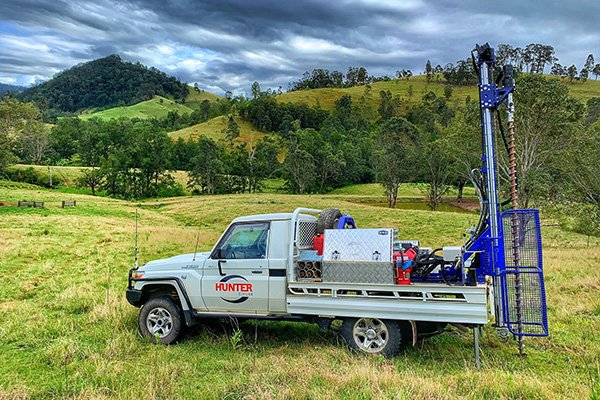
Our 4WD-mounted rigs are used for geotechnical and environmental site investigations, pavement investigations, sampling and monitoring well installation. They drill to depths of up to 10m, depending on material type and density, and their compact 6m footprint makes them our go-to for tight-access sites.
Trailer-mounted rig
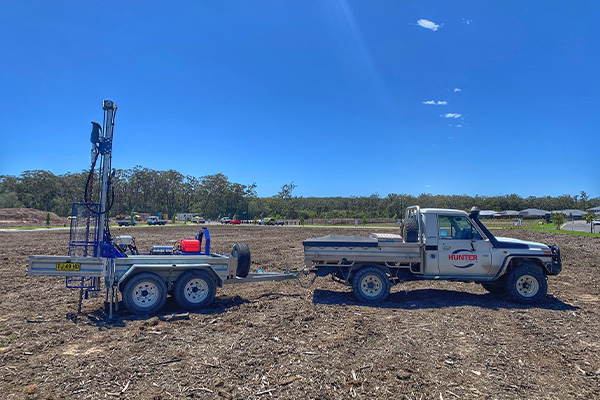
Our trailer-mounted rig has the same drilling capability as our 4WD-mounted rigs: geotechnical and environmental site investigations, pavement investigations, sampling and monitoring well installation, to depths of up to 10m depending on ground conditions.
Track-mounted rig
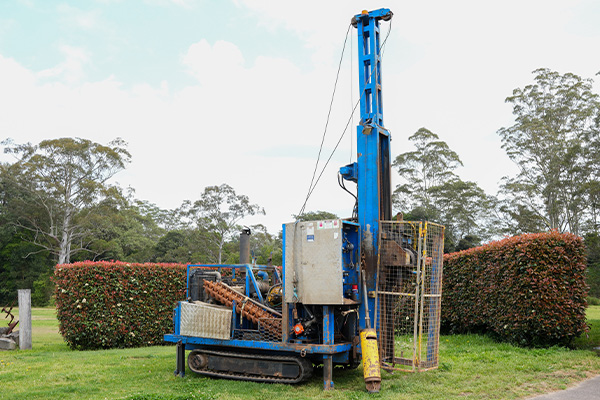
Our track-mounted rig is built for restricted and sensitive sites. It fits through a 1.8m wide, 2.5m high opening, works with a 4.9m mast and tracks across steep, soft and uneven ground. It cores to 55m, wash bores to 45m, and augers and SPT samples to 35m.
Compare our drilling rigs
| Rig | Travel size (L x W x H) | Working height | Drilling depth |
|---|---|---|---|
| 4WD-mounted rigs (x2) | 6m x 2.2m x 3m | 4m | Up to 10m* |
| Trailer-mounted rig | 10m x 2.2m x 2.2m | 4.4m | Up to 10m* |
| Track-mounted rig | 3.0m x 1.8m x 2.5m | 4.9m | Up to 55m (coring) |
*Depth depends on material type and density.
How our drilling supports your project
Subsurface Exploration & Soil Sampling
Soil and rock sampling to reveal ground conditions, with samples tested at our Thornton laboratory to assess suitability for construction and environmental safety.
Geotechnical Drilling & Investigations
Borehole drilling, sampling and in-situ testing for geotechnical investigations to AS1726, foundation design, slope stability and mine subsidence assessments.
Site Classifications
Drilling for residential and commercial site classifications to AS2870, including sites where standard rigs can’t get access.
Environmental Drilling & Investigations
Environmental drilling, push-tube sampling and soil sampling to assess contamination in soil and groundwater, supporting Preliminary and Detailed Site Investigations, acid sulfate soil assessments and VENM, ENM and waste classifications.
Monitoring Wells Installation & Analysis
Installation of groundwater monitoring wells for long-term data on water quality, flow and contamination.
Drilling methods

- Solid flight augering (90mm to 350mm)
- Undisturbed tube sampling
- Bulk sampling
- Diamond coring of rock and concrete
- Wash boring
- Standard Penetration Testing (SPT)
- Push-tube sampling for environmental investigations
- Monitoring well installation
Laboratory tests

Samples go straight from the rig to our Thornton laboratory.
Rock testing
- Point Load Strength Index (AS4133.4.1) – NATA accredited
- Uniaxial Compressive Strength (AS4133.4.2.1 and AS4133.4.2.2)
- Rock moisture content (AS4133.1.1)
Soil and concrete testing
- Atterberg limits and shrink swell
- DCP and CBR
- Acid sulfate soils
- Permeability
- Concrete compressive strength

Frequently Asked Questions
1. What is the importance of geotechnical drilling in construction?
Geotechnical drilling provides critical data about subsurface conditions, helping engineers design foundations, pavements, and structures that are safe and sustainable. It also helps identify potential hazards such as unstable soil or groundwater issues.
2. How is environmental drilling different from geotechnical drilling?
Environmental drilling focuses on assessing soil and groundwater contamination. It helps identify pollutants, monitor environmental health, and develop remediation strategies, while geotechnical drilling primarily focuses on soil stability and structural design.
3. What are monitoring wells used for?
Monitoring wells are installed to track groundwater conditions over time, helping assess water quality, detect contamination, and guide environmental remediation efforts.
4. Can you drill on sites with limited access?
Yes. Our track-mounted rig needs only 1.8m width and 2.5m height to get onto site, and it works with a 4.9m mast. It’s suited to substations, car parks, warehouses, backyards and other restricted sites. Trak-Mats are available to protect sensitive surfaces.
5. How deep can you drill?
Depth depends on the rig and the ground. Our 4WD-mounted and trailer-mounted rigs drill to depths of up to 10m, depending on material type and density. Our track-mounted rig can core to 55m, wash bore to 45m, and auger and SPT sample to 35m.
6. What tests can you do on rock core?
Our Thornton laboratory carries out Point Load Strength Index testing (NATA accredited), Uniaxial Compressive Strength testing and rock moisture content testing on core recovered by our rigs.
Geotechnical Drilling & Investigation
Contact us about your next drilling project
Talk to our team about drilling, testing and reporting for your project across the Central Coast, Hunter and Mid North Coast.
Partner with us on your next project
Contact our specialised team for more information about our services.