
Advanced Pavement Strength & Compliance Testing
Falling Weight Deflectometer (FWD) Testing
Our Focus
Hunter Geotechnical Services provides Falling Weight Deflectometer (FWD) testing for pavement asset management, rehabilitation planning, and construction compliance.
FWD testing delivers a high‑precision, non‑destructive assessment of pavement structural capacity, enabling more reliable decision‑making than traditional deflection testing methods.
The FWD is widely used by councils, road authorities and civil contractors to support:
- pavement rehabilitation and overlay design
- asset management programs
- construction control and compliance testing
- pavement performance investigations
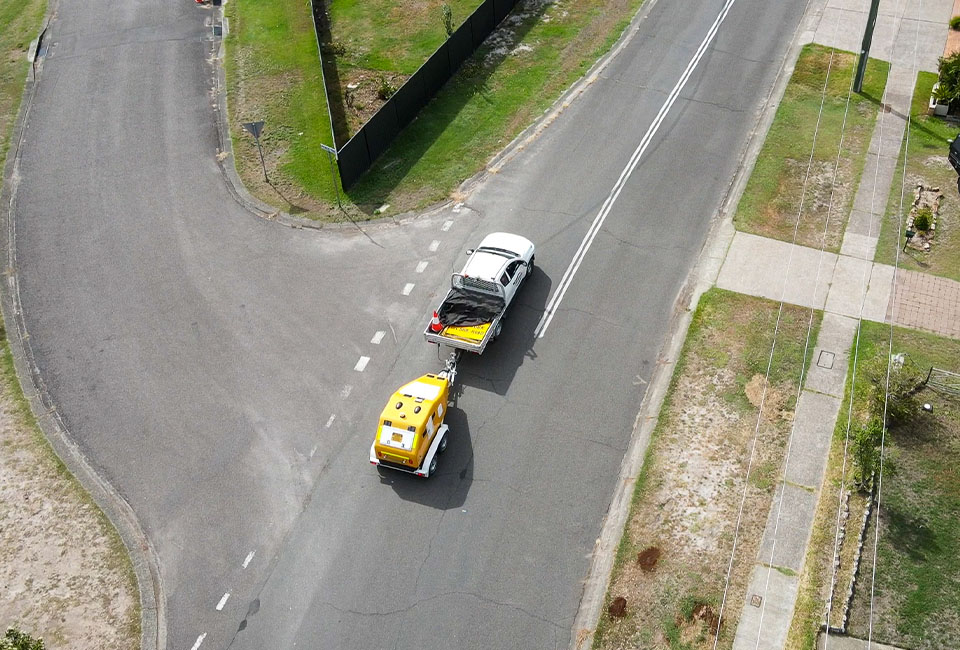
Hunter Geotechnical Services owns and operates a Heavy Weight FWD, allowing testing across a wide range of pavement types – from local roads through to high‑strength and specialised pavements.
Our Services
Comprehensive Falling Weight Deflectometer Testing
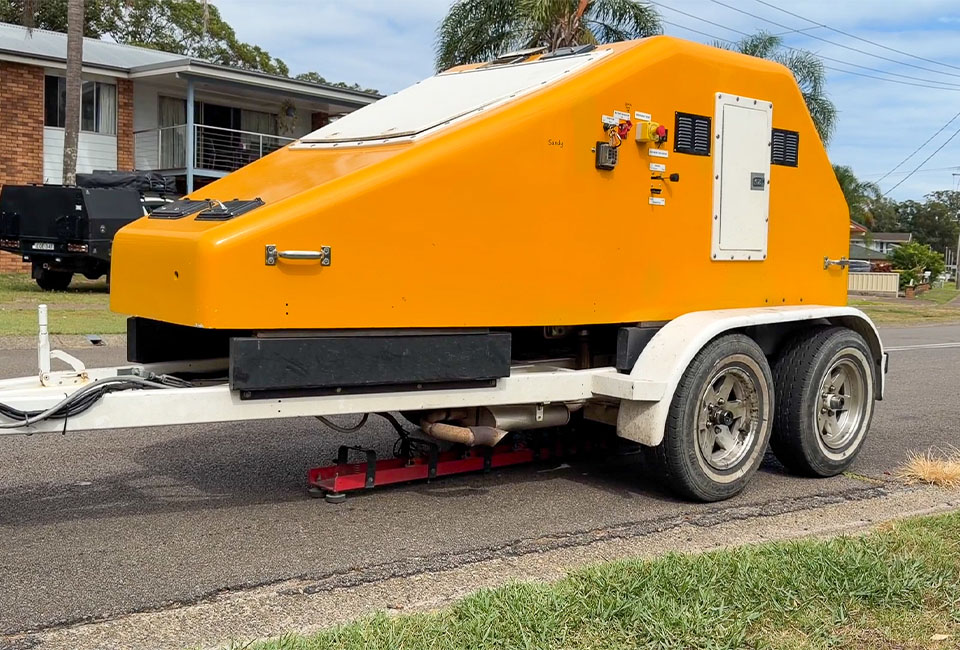
FWD testing measures the deflection response of pavement layers under a dynamic, controlled load, closely simulating real traffic loading conditions. Multiple sensors (geophones) capture the resulting deflection bowl, providing insight into the performance of individual pavement layers.
Unlike traditional static methods, the FWD:
- measures the actual applied force via a load cell
- normalises deflections for slope, camber and surface conditions
- produces highly repeatable, low‑uncertainty results
This results in more consistent data, reduced reliance on operator technique, and improved confidence in both design and compliance outcomes.
Applications of FWD Testing
Pavement Asset Management
FWD testing is a key tool for councils and asset owners to:
- assess in‑service pavement strength
- prioritise rehabilitation works
- optimise renewal programs
- improve life‑cycle decision‑making
The data supports evidence‑based budgeting and helps avoid premature rehabilitation or unnecessary expenditure.
Construction Control & Compliance Testing
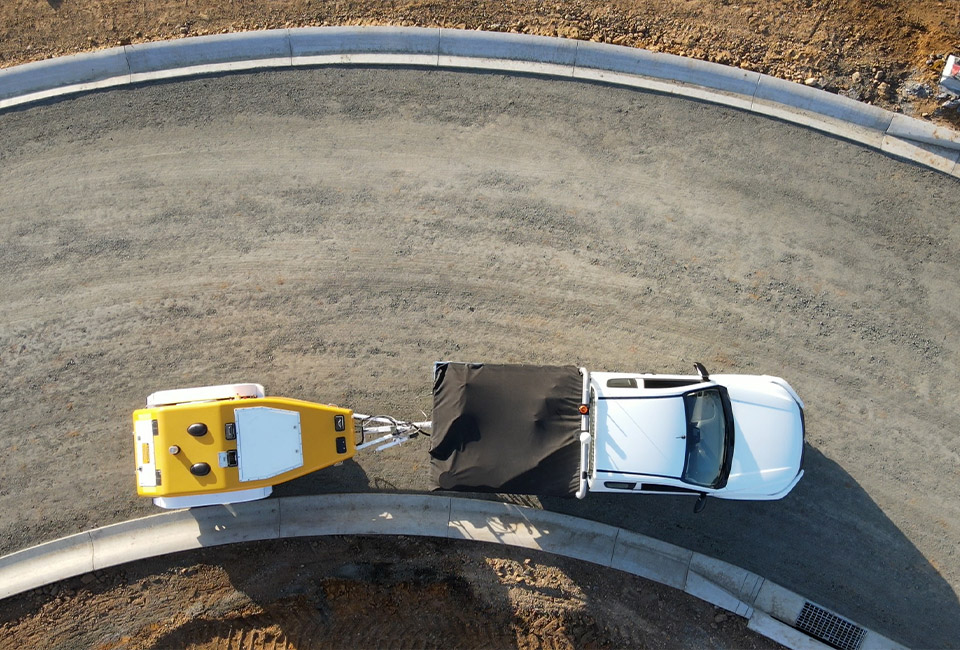
FWD testing can be used in lieu of Benkelman Beam testing for construction control, where accepted by the relevant authority.
It is particularly well suited to:
- pre‑seal and pre‑asphalt pavement acceptance
- verification of pavement layer performance
- validation of construction quality
FWD testing offers improved precision and repeatability, reducing the risk of false passes or marginal failures driven by testing variability rather than pavement condition.
Pavement Investigation & Rehabilitation Design
FWD results provide high‑quality input data for:
- overlay and rehabilitation design
- remaining life assessments
- identification of weak pavement layers
- targeted treatment selection
By understanding how the pavement responds under load, more effective and economical rehabilitation strategies can be developed.
Why Use FWD Instead of Traditional Deflection Testing?
Compared to Benkelman Beam testing, FWD offers:
- Higher accuracy and repeatability
Deflections are measured in microns with minimal influence from wind, vibration, or operator technique. - Dynamic load measurement
The applied force is measured and normalised, accounting for road camber, slope and pavement variability. - Improved safety
Single‑operator testing from within the vehicle reduces exposure of personnel on live roads. - Faster testing and mobilisation
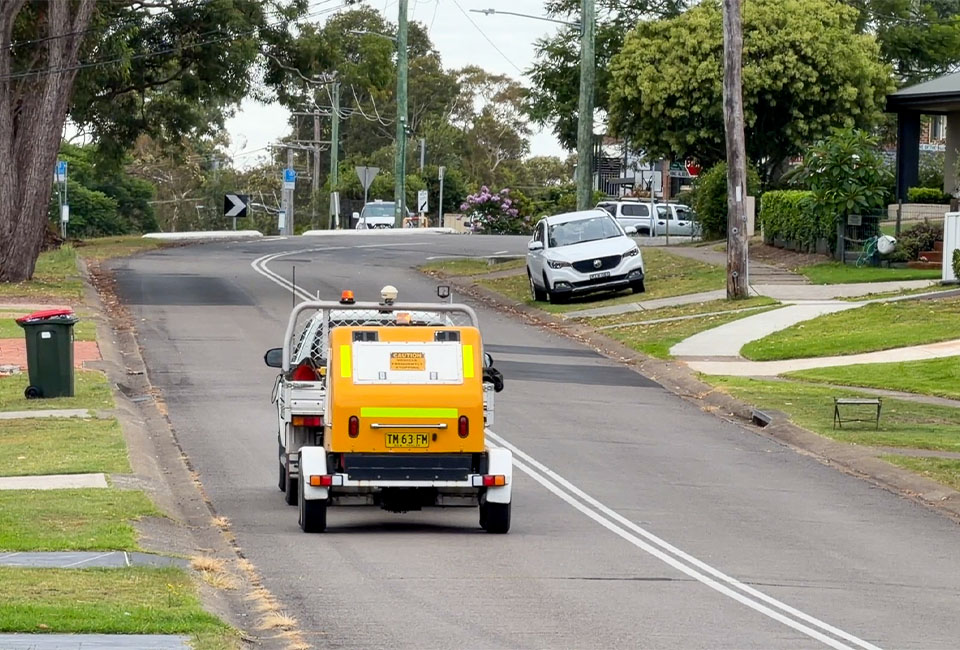
A trailer‑mounted unit towed by a light vehicle allows quicker setup and testing. - Richer data outputs
Full deflection bowl data supports deeper analysis beyond a single deflection value.
Hunter Geotechnical Services also undertakes direct comparison testing to demonstrate equivalence between FWD and traditional methods in line with Austroads guidance.
Traffic Control Options
Where appropriate, FWD testing can be undertaken without traffic control (traffic signage only under a Generic Traffic Guidance Scheme – TGS) on low‑volume roads, subject to defined safety criteria and pre‑test risk assessment.
This offers:
- reduced disruption to residents and road users
- shorter test durations
- lower project costs
Where conditions do not allow, FWD testing is undertaken with full, compliant traffic control arrangements.
All testing is supported by documented risk assessments and site‑specific safety controls.
Reporting & Deliverables
FWD testing reports can include:
- raw and normalised deflection data
- characteristic deflection and statistical analysis
- equivalent Benkelman beam deflection (for 40kN load parameter)
- inferred subgrade CBR (where applicable)
- pavement condition observations
- surface modulus and deflection indices
- data suitable for input into pavement design and asset management systems
Advanced analysis – including remaining life and overlay assessments – can be provided through Hunter Geotechnical Services’ engineering team.

Frequently Asked Questions
Is FWD testing accepted by councils and road authorities?
FWD testing is widely recognised and supported by Austroads research. Acceptance depends on authority requirements and project context.
Can FWD replace Benkelman Beam testing?
In many construction control and investigation applications, yes – subject to specification acceptance.
Does FWD testing damage the pavement?
No. FWD testing is non‑destructive and does not compromise pavement integrity.
Why choose Hunter Geotechnical Services?
- Ownership and operation of a Heavy Weight FWD
- Experienced technicians trained in FWD operation and interpretation
- Proven experience with councils, transport authorities and civil contractors
- ISO 9001 certified quality management systems
- Strong safety and environmental management focus
- Integration with broader geotechnical and construction materials services
Our FWD capability allows clients to access high‑quality pavement data locally, without reliance on interstate mobilisations or outsourced providers.
Specialist Capability
See the FWD in Action
Watch Hunter Geotechnical Services’ Heavy Weight FWD unit on a live pavement testing job – from setup through to data capture.
The FWD operates as a trailer-mounted unit towed by a light vehicle, with a single operator conducting testing from within the cab. No drilling, no lane closures on suitable roads, and results ready for analysis the same day.
Speak With an Expert
If you would like to discuss whether FWD testing is suitable for your project, rehabilitation program or construction works, contact Hunter Geotechnical Services to speak with one of our engineers.
Partner with us on your next pavement project.
Partner with us on your next project
Contact our specialised team for more information about our services.